


Basic culinary techniques decide how a dish turns out long before any recipe does. A pan that is not hot enough will never brown the meat, and a sauce that boils too quickly will split. French chefs spent generations working out these small details, which is why most culinary schools build their first lessons around French cooking techniques. Once a student gets them right, the same habits carry over to Indian, Italian and everyday home cooking.
This blog goes through the main French methods and the knife skills that go with them. It also covers the five mother sauces, how chefs season food, and a few simple ways to practice on your own at home or in a culinary class.
Table of Content
What Are French Cooking Techniques and Why Are They Important?
What Basic Culinary Techniques Should Every Cooking Student Learn?
Which Knife Skills Are Essential for Professional Cooking?
What Are the Five French Mother Sauces Every Culinary Student Should Know?
Which French Cooking Methods Are Used to Prepare Different Ingredients?
How to Master Sautéing, Roasting, Braising and Poaching?
How Do French Chefs Use Herbs, Seasonings and Aromatics?
What Is the Difference Between Julienne, Brunoise, Chiffonade and Dice?
How Do French Culinary Techniques Improve Food Presentation?
How Can Culinary Students Build Professional Kitchen Skills?
Final Takeaway: Mastering French Cooking Techniques for a Culinary Career
Frequently Asked Questions
What Are French Cooking Techniques and Why Are They Important?
French cooking techniques started in French kitchens, and Auguste Escoffier gave them their structure in his 1903 book, Le Guide Culinaire. At heart, they are about what happens when food meets heat, liquid or fat. Sear a steak in a hot pan and you get a brown crust. Leave the same cut in a pot with wine for three hours and you can cut it with a spoon.
Most culinary schools begin here, and the reason is practical. The same mistakes show up again and again. A cold pan won’t brown anything, a sauce heated too fast splits, and onions burn the moment you walk away. Learn that once with a French dish and you’ll spot it in a dal tadka or a pasta sauce too. That’s why basic culinary techniques are usually taught through French recipes first, and why kitchens still say “mise en place” and “sauté” every day.
What Basic Culinary Techniques Should Every Cooking Student Learn?
Most basic culinary techniques fall into two groups. Dry-heat methods like sautéing, roasting, grilling and frying use hot air, fat or direct heat. Moist-heat methods like boiling, steaming, poaching and braising cook food in liquid or steam. Then there is prep work. Mise en place, meaning you cut and measure everything before the stove goes on, saves you from panic mid-service. Add food safety, like correct storage temperatures, and you have the base every cook need before trying anything fancier.
Which Knife Skills Are Essential for Professional Cooking?
Knife skills make a bigger difference in the kitchen than most people expect. They affect how fast you work and how evenly your food cooks. Cut potatoes in different sizes and the small bits turn to mush while the big ones are still hard in the middle. Cut them the same size and they’re done together.
Start with the grip. Pinch the blade just above the handle with your thumb and index finger, then wrap the rest of your fingers around the handle. Use your other hand to hold the food, with the fingertips tucked in like a claw, so the knife runs against your knuckles and not your fingers. Put a damp cloth under the board so it doesn’t slide and keep the knife sharp. A blunt knife is the one that slips.
Once the grip feels natural, work on your knife cooking skills: slicing, rocking the blade over herbs, trimming, peeling and honing the edge. Take it slow at first. Speed shows up once your cuts come out even.
What Are the Five French Mother Sauces Every Culinary Student Should Know?
The five French mother sauces were codified by Escoffier and form the base for hundreds of derivative sauces.
- Béchamel: milk thickened with a white roux, used in gratins and lasagne.
- Velouté: white stock of chicken, veal or fish thickened with a blond roux.
- Espagnole: brown stock thickened with a brown roux, with tomato and mirepoix; the base of demi-glace.
- Hollandaise: an emulsion of egg yolk and clarified butter, brightened with lemon juice.
- Sauce tomate: cooked tomatoes with aromatics, often finished with a little stock or fat.
Each sauce teaches a separate skill: roux cooking, stock handling, reduction, emulsification and seasoning. Hollandaise, for example, trains temperature control, since overheated yolks scramble. Once these five are understood, variations such as mornay, supreme, bordelaise and béarnaise follow with small changes.
Which French Cooking Methods Are Used to Prepare Different Ingredients?
Every ingredient cooks best with a particular method, and French cooking techniques are built around that idea. Chicken breast, fish fillets and thin steaks are tender, so they do well with quick cooking like sautéing, grilling or poaching. Tougher cuts like beef shin or lamb shoulder need hours in liquid. Braising breaks down the tough bits until the meat falls apart.
Root vegetables are best roasted, since the dry heat brings out their sweetness. Eggs and delicate fish like a gentle poach. For green vegetables, drop them in salted boiling water for a minute, then straight into ice water so they stay bright green. Before you light the stove, ask yourself one question: what is this ingredient best suited to?
How to Master Sautéing, Roasting, Braising and Poaching?
- Sautéing: The word comes from the French sauter, which means “to jump”, and that’s pretty much what the food does in the pan. Heat a wide pan first, add a little fat, then toss in evenly cut pieces and keep them moving. The most common mistake is packing in too much food. The pan cools down and the food steams instead of browning.
- Roasting: Roasting is dry heat in the oven, usually somewhere between 180°C and 230°C. Pat the meat dry, season it early and let it rest after cooking so the juices settle back in. Go by a thermometer instead of the clock. It’s far more reliable.
- Braising: Sear the main ingredient first for color, then cook it slowly in a covered pot with liquid that comes partway up the sides. Coq au vin and braised short ribs are the classic examples. Once the meat is tender, you can boil down the leftover liquid into a sauce.
- Poaching: Poaching means cooking food in liquid kept at around 70°C to 85°C, which is just below a simmer. The gentle heat sets the protein without making it tough. Depending on the dish, you can use stock, a wine-based court-bouillon or just lightly seasoned water.
How Do French Chefs Use Herbs, Seasonings and Aromatics?
French cooks build flavor in layers, starting with the aromatics. Onion, carrot and celery, together called mirepoix, get cooked slowly at the start to make the flavor base. The usual ratio is two parts onion to one part carrot and one part celery. For lighter dishes, cooks use shallots, garlic and leeks in the same way.
Herbs go in at different times. A bouquet garni is a small bundle of thyme, bay leaf and parsley stems tied together. It simmers with the dish and comes out before serving. Fines herbes, a mix of parsley, chervil, tarragon and chives, go in near the end because long cooking kills their flavor. Salt is added in small amounts along the way, not all at once, and a squeeze of lemon or a splash of vinegar at the end brightens everything. Most importantly, French cooks taste as they go.
What Is the Difference Between Julienne, Brunoise, Chiffonade and Dice?
These cuts differ in shape and size:
- Julienne: thin matchsticks about 3 mm thick and 5 to 6 cm long, used in salads, stir-fries and garnishes.
- Brunoise: tiny cubes of about 3 mm, made by dicing julienne strips crosswise, common in sauces and soups.
- Chiffonade: thin ribbons made by stacking leaves such as basil or spinach, rolling them tightly and slicing across.
- Dice: cubes in small (about 6 mm), medium (about 12 mm) and large (about 20 mm) sizes, chosen by cooking time.
These measurements follow common classical standards, and some kitchens adjust them slightly. What matters is consistency within a batch.
How Do French Culinary Techniques Improve Food Presentation?
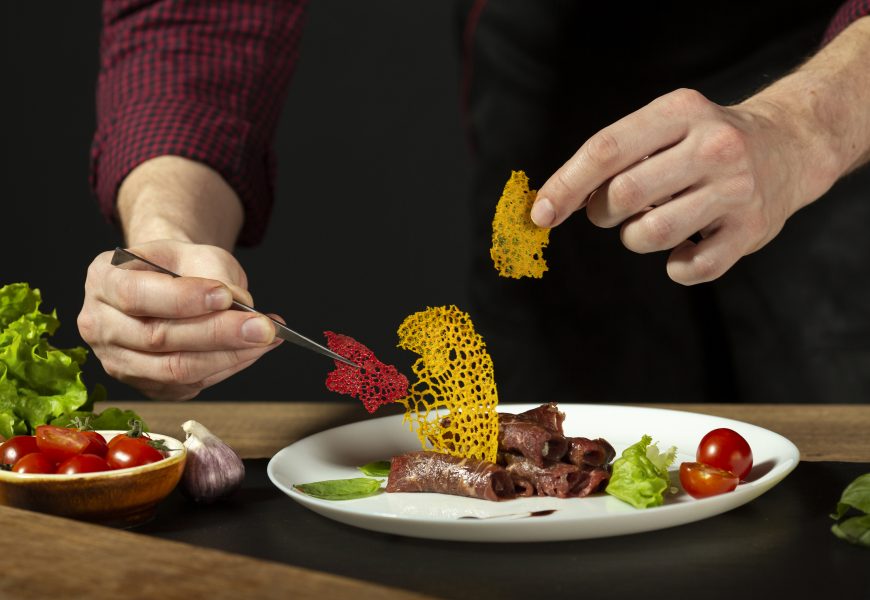
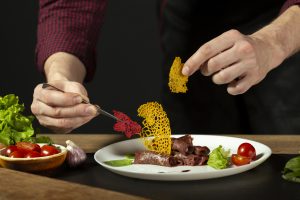
Technique and presentation are closely linked. Uniform knife cuts make vegetables look neat on the plate. A properly reduced sauce coats the back of a spoon and sits cleanly beside the main item instead of flooding the plate. Even browning from correct sautéing or roasting adds colour that garnish cannot replace.
French plating generally favours restraint: a clear focal point, deliberate sauce placement and a garnish that can be eaten. Clean plate rims, balanced colours and sensible portions also matter. Presentation is not decoration added at the end. It reflects how carefully each earlier step was done.
How Can Culinary Students Build Professional Kitchen Skills?
Professional kitchen skills grow through repetition with feedback. A practical routine for culinary students includes:
- One knife cut practised daily on inexpensive vegetables such as onions, carrots and potatoes.
- One mother sauce cooked each week, with notes on texture and seasoning.
- A single technique, such as sautéing chicken, repeated until results are consistent.
- A notebook recording times, temperatures and adjustments.
- Guidance from a chef-instructor who can correct grip, timing and hygiene habits early.
Speed, cleanliness and organisation also count in professional settings. Working neatly, cleaning as the work progresses and following food safety rules become habits through regular practice. Structured diploma programs add supervised assessment, which helps students spot weak areas sooner.
Final Takeaway: Mastering French Cooking Techniques for a Culinary Career
French cooking techniques give culinary students a clear framework: understand the ingredient, choose the method, control heat and time, and season in stages. Basic culinary techniques, supported by sound knife skills, make that framework usable in any kitchen. Progress comes from steady practice, honest tasting and feedback from experienced chefs. For students who want a structured route, AAFT Online’s one-year Diploma in Culinary Arts, recognised by Worldchefs, moves from culinary foundations to advanced techniques and professional development. It gives learners the guided practice needed to build these skills and prepare for opportunities in professional kitchens.
Frequently Asked Questions
1. What are the 10 most common cooking techniques used by chefs?
The ones you’ll see in almost every kitchen are sautéing, roasting, braising, poaching, grilling, boiling, simmering, steaming, frying and baking. Blanching, deglazing and reducing also come up all the time. They’re smaller techniques, but a lot of recipes depend on them.
2. What is the easiest French dish for a beginner to cook?
A classic French omelette is a good place to start. All you need is eggs, butter and salt, and it’s done in about two minutes. In that short time you learn how to control heat, move the pan and get the timing right. A simple vinaigrette is another easy option if you’d like something with no cooking at all.
3. What are the seven basic knife cuts used in professional kitchens?
Lists differ a little from school to school. The cuts most often taught are batonnet, julienne, brunoise, small dice, medium dice, large dice and chiffonade. Some longer programs also add mincing and paysanne cuts.
4. How can beginners improve their knife skills in the kitchen?
Regular practice on vegetables builds knife cooking skills fastest chefs say. Beginners should focus on a grip a stable board and a sharp knife. Cut slowly for pieces and increase speed only when accuracy is consistent.
5. What is the difference between chopping, dicing and mincing?
Chopping produces pieces of uneven size dicing produces uniform cubes and mincing produces very fine pieces, usually for garlic, ginger or herbs. The difference lies in size and consistency which affect cooking time and texture for chefs.
6. What kitchen equipment does a culinary student need to practice French cooking?
You don’t need much to get started. An eight-inch chef’s knife and a paring knife cover most of the cutting, and a honing steel keeps them sharp. Add a cutting board, a heavy-bottomed sauté pan, a saucepan and a casserole dish. A whisk, a pair of tongs and a kitchen thermometer finish the list.
7. Can you learn professional cooking techniques without attending culinary school?
Yes, plenty of cooks learn through practice, books and video tutorials. The catch is that nobody tells you what you’re doing wrong. Culinary school or a structured diploma gives you feedback from working chefs, a proper order to learn things in, and a recognised certificate, which helps when you apply for jobs in professional kitchens.

















Comments (0)