


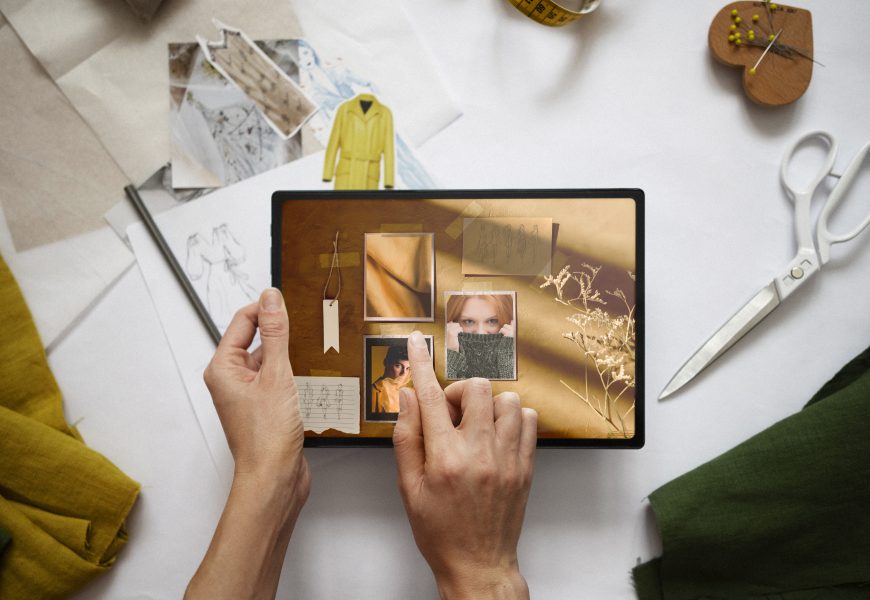
A fashion design mood board is a single page of pictures, colors and fabric bits that shows the feel of a collection before you’ve sketched a single thing. You choose a theme, collect far more images than you need, then cut them down hard and stick the survivors around one main picture, with real swatches next to them. Sketches follow from that, and your garment specification sheet follows from the sketches. Paper is fine for a first attempt. So is Canva.
Say you’re planning a collection around the old havelis of Shekhawati. In your head it’s obvious: peeling paint, carved wooden doors, that dusty orange light just before sunset. Your pattern maker has never seen any of it, though. You could talk for an hour, or you could put ten photographs in front of them. That’s what a mood board is. If you skip it, the sketches slowly drift and each one ends up a bit off from the last.
In this blog you’ll find what a mood board is and why designers use one, then the steps to make one, where to look for fashion mood board ideas, and what should go on the board. We also cover choosing colors, fabrics and prints, building a digital version, and turning the board into garment sketches. You’ll read about the garment specification sheet too, along with common beginner mistakes and how to show your board in a portfolio.
Table of Content
What Is a Fashion Design Mood Board and Why Is It Important?
How to Create a Fashion Design Mood Board Step by Step
Where to Find Inspiration for a Fashion Collection
What Elements Should a Fashion Mood Board Include?
How to Choose Colours, Fabrics, Textures and Prints for Your Mood Board
What Are the Best Fashion Mood Board Ideas for Beginners?
How to Create a Digital Fashion Mood Board Using Online Tools
How to Organise Images and Develop a Clear Design Theme
How to Turn a Fashion Mood Board into Garment Designs
What Is a Garment Specification Sheet and What Does It Include?
What Common Mistakes Should Beginners Avoid When Creating a Mood Board?
How Can Fashion Students Present a Mood Board in Their Design Portfolio?
Final Takeaway: From Fashion Inspiration to a Finished Design Concept
FAQs
What Is a Fashion Design Mood Board and Why Is It Important?
A mood board is a page, on paper or on a screen, where you collect the look of a collection. Photographs, colour chips, and little pieces of fabric go on it. Some people add lace, a ticket stub, a leaf they liked.
It’s not a design, though. A fashion design mood board can’t be worn, and it doesn’t need to be tidy. All it has to do is show people where you’re heading.
And that helps more than you’d think. Tell a tailor, a pattern maker, and a client that the collection is “earthy and relaxed,” and you’ll get three completely different outfits back. Put one board in front of all three, and they mostly agree. Later on, when a sketch feels wrong, hold it up next to the board. You’ll usually spot what changed.
How to Create a Fashion Design Mood Board Step by Step
To make a fashion design mood board, follow these steps in order.
- Pick a theme, and make it narrow. “Rajasthani stepwells” works. “Nature and vibes” doesn’t.
- Collect images, way more than you need, maybe fifty. They can come from magazines, your phone, an old family album, wherever.
- Now cut. You want the best ten or fifteen. This is the slow part, since you’ll love a few pictures that just don’t fit, and they have to go.
- Add real fabric swatches and a few color chips.
- Put the biggest image down first (middle of the page is fine) and arrange the rest around it.
- Write three or four keywords somewhere on the board. Faded, soft, handmade, whatever fits.
A first board can be chart paper and a glue stick.
Where to Find Inspiration for a Fashion Collection
Look around you first. What people wear in your city, an old sari in the family trunk, a carved temple wall, a market stall with a hundred dupattas hanging off it. Bandhani, Ajrakh and Kantha are worth a look, and so are museums. Good fashion mood board ideas rarely come from fashion magazines alone.
Pinterest and Behance help for extra references. The catch is that lots of designers pull from the same feeds, so the boards end up looking alike. Add one or two things that are yours. A photo from your own phone. A page from a notebook.
What Elements Should a Fashion Mood Board Include?
Boards can be simple, but a few things should always be on there.
- A theme title, or one line about the theme
- A hero image that sets the mood
- A color palette of four to six shades
- Fabric swatches and textures
- Print or pattern references
- Silhouette references (flared, boxy, fitted)
- A short note about who’ll wear the clothes. A board for college students and a board for brides will look quite different.
If something’s missing, someone will ask about it in your review.
How to Choose Colors, Fabrics, Textures and Prints for Your Mood Board
Color and fabric decide how a collection feels when it’s worn, and a screen can’t show that part.
- One base color and two or three accents. Six strong colors together is usually too much.
- Take the colors from your hero image, with a color picker or just by looking.
- Pin real fabric. Cotton and satin in the same blue don’t look the same at all.
- Try rough khadi beside smooth silk and see how the contrast feels.
- Keep an eye on print size, because a big floral can look strange on a small top.
- Season matters too. Heavy wool doesn’t belong on a summer board.
Try every choice on real cloth before you decide.
What Are the Best Fashion Mood Board Ideas for Beginners?
Not sure where to start? Try a season, like monsoon in Kerala. Or a place, like the ghats of Varanasi. Or a decade, maybe the nineties with oversized shirts and washed denim. These are all easy fashion mood board ideas for beginners, since there are loads of images already.
You can also build one around a single fabric, khadi for example, or a painting, or a film you keep thinking about, or old clothes you want to upcycle. Choose the one you could talk about for five minutes without running out.
How to Create a Digital Fashion Mood Board Using Online Tools
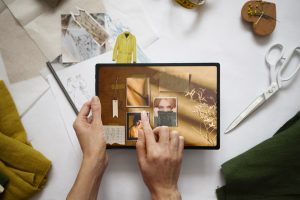
A digital board is easy to edit and easy to send. Canva, Pinterest and Google Slides are all free. Photoshop and Illustrator give you more control, but most beginners don’t need that. Try a few fashion mood board ideas as rough layouts first, then finish the one you like best.
- Open a blank canvas, A4 or 16:9.
- Use high-resolution images, because small ones go blurry when you enlarge them.
- Keep the grid simple: one big image, smaller ones around it.
- Two fonts at most.
- Export as PDF or PNG.
Save a copy before big edits.
How to Organize Images and Develop a Clear Design Theme
Before you place anything, sort the images into piles. Color, texture, silhouette, mood. If a picture doesn’t fit any pile, it probably shouldn’t be on the board. After that, choose one hero image and build the layout around it.
Then try to write the theme in one sentence, something like “soft, sun-faded linen for slow weekends”. If it becomes a paragraph, you’ve got too many ideas on the board and need to cut more.
How to Turn a Fashion Mood Board into Garment Designs
Look at the finished board and ask yourself what it suggests. Sketch eight to ten rough looks and bring them down to five or six. The colors and fabrics come straight from the board, and the silhouettes should stay close to your references.
Then do flat sketches of each look, front and back, with pockets, seams, and any small details shown. Keep them neat and to scale, because they go into your garment specification sheet.
What Is a Garment Specification Sheet and What Does It Include?
A garment specification sheet is the document a factory or tailor follows to make a garment. Your idea goes in one end, and a sample comes out the other.
Inside, you’ll find the flat sketch, then measurements with tolerance, fabric and trim details, stitching and seam notes, color references, labels and packaging. If any of it is missing, the sample comes back wrong, and wrong samples cost money. That’s reason enough for beginners to learn this early.
What Common Mistakes Should Beginners Avoid When Creating a Mood Board?
These come up again and again with beginners.
- Too many themes on one board
- Copying a Pinterest board and adding nothing of your own
- Ignoring fabric until sketching starts, then finding out the fabric you wanted doesn’t drape the way the sketch needs
- Filling every inch of the layout
- Forgetting who will actually wear the clothes
Sorting these out improves the next board a lot.
How Can Fashion Students Present a Mood Board in Their Design Portfolio?
In a portfolio, the fashion design mood board goes on the first page. It shows how you think before anyone looks at a sketch. After it come the sketches, the flats, and photographs of the finished garment.
Keep every page clean and label everything. Include a spec sheet for at least one piece. AAFT Online’s Diploma in Fashion Design has a portfolio module and 14 projects, and students receive a kit with mood board templates, color guides and fabric swatches.
Final Takeaway: From Fashion Inspiration to a Finished Design Concept
A mood board gives your ideas a direction, and a spec sheet turns them into something a factory can make. Pick one theme, collect, cut, and test on real fabric.
For structured guidance, AAFT Online’s one-year, fully online Diploma in Fashion Design covers 56 modules. It is certified by NSDC and CII and recognized by FDCI.
Read More – Fashion Designing Courses After 12th
FAQs
1. What is the difference between a fashion mood board and a fashion design board?
A mood board is the early stuff: photos, colors, a fabric scrap or two, just to show the feeling. The design board is what you make once you’ve started sketching, with the drawings, final fabrics and trims on it. Mood first, design second, and they look nothing alike.
2. How many images should a fashion mood board have?
Around ten to fifteen, but it isn’t a rule. A strong board with eight pictures beats a messy one with thirty. Collect a big pile first, then keep taking things off until only the pictures that feel like they belong together are left on the page.
3. Can I make a fashion mood board without drawing skills?
Yes, you can. Nobody asks you to draw anything for a mood board; you’re just choosing and sticking. Cut pictures out of old magazines, add a bit of fabric, and that’s it. Sketching starts afterwards, and courses like the one at AAFT Online begin with really basic lines and shapes.
4. Which free tools can I use to create a fashion mood board?
Canva, mostly. It’s free, it’s simple, and there are layouts you can change. Pinterest is handy for saving pictures before you build anything, and Google Slides works if you want a plain layout. Some students still prefer chart paper, glue, and real swatches, because you can feel the cloth.
5. How do I choose a color palette for a clothing collection?
Look at your main image and pick the colors that jump out first, around four to six of them. Before you finalize anything, hold your fabric swatches next to a window and compare, because screens change colors more than you’d think.
6. What is the difference between a mood board and a storyboard in fashion?
A mood board has no order. A storyboard does have an order, so it shows looks one after the other, the way you’d walk someone through a collection or a show. The same pictures could sit on both, but they’re doing different jobs.












Comments (0)